Why providers restrict targets
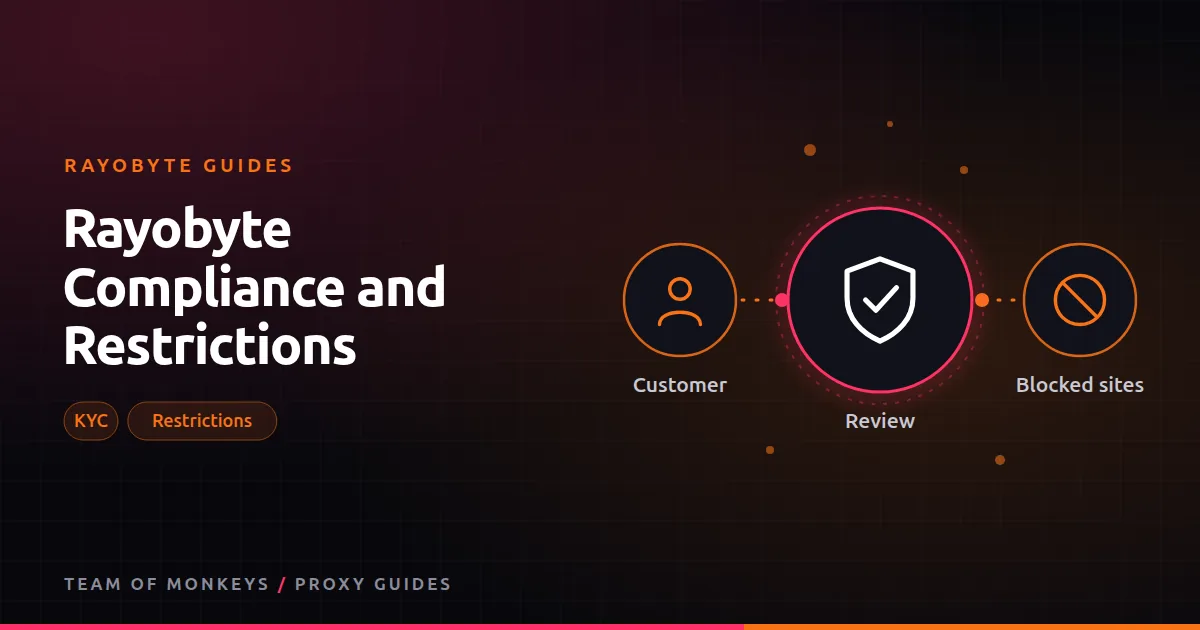
A residential proxy network is made of real people's connections. If customers use it for fraud, the people behind those IPs and the provider both suffer. Responsible providers therefore block the targets most associated with abuse and vet customers whose usage looks risky. Rayobyte is explicit about its rules, which is useful: you can plan around them before you build.
What's blocked on residential
At the time of writing, Rayobyte says it blocks these categories on its residential network for all customers:
- Banks and other financial account sites.
- Government sites.
- Login pages.
- Sites that report abuse to Rayobyte.
The aim is to stop credential stuffing, account takeover, benefit fraud and similar abuse from running over residential IPs.

ID checks
Rayobyte says unusual use triggers ID checks, and that it knows every paying customer. "Unusual" isn't defined publicly, but sudden spikes, patterns that look like account attacks, or traffic to sensitive categories are the obvious candidates. If you're asked to verify, answer promptly with a clear description of your project; most legitimate projects pass easily.
The Scale Residential review
Scale Residential is sold only to verified businesses after a compliance review. Be ready to explain:
- Who your company is and what it does.
- What data you collect and from which kinds of sites.
- How you'll use the data.
- Your expected volume and concurrency.
While the review runs, you can build and test on the Premium Residential free trial.
Residential tip: You can test most of this guide for free: Rayobyte offers a no-card trial on Premium Residential, rotating ISP and rotating datacenter proxies. Move to a paid plan once the pilot works. See our complete Rayobyte guide.
Planning legitimate projects around the rules
You need logged-in access to your own accounts. Use static ISP proxies, which Rayobyte points account users to, and keep one IP per account. Check the current terms for your platform.
You're doing public data collection. Product pages, search results, listings, reviews and news are generally unaffected. See Rayobyte for web scraping.
You're researching financial data. Public market data sites and news are different from bank login pages, but check before you build. See Rayobyte for market research.
You're doing security research. Get explicit authorization for anything beyond public pages, and talk to Rayobyte first if your targets are sensitive.
You're monitoring government data. Public government data is often available through official downloads or APIs, which are better than scraping anyway.
The legal side
Proxy rules aren't the same as the law. A target can be allowed by your provider and still be off limits under the site's terms or local law, and vice versa. Respect robots rules where they apply, don't collect personal data you don't need, and don't bypass logins you aren't entitled to. See are proxies legal and ethical web scraping.
What happens if you break the rules
Expect a warning, suspension or termination, and Rayobyte says it acts on abuse reports within one business day. Beyond the account risk, abusing a residential network harms real people. It's not worth it.
Proxy tip: For a second opinion on hard targets, run the same test through Geonode residential proxies, which support sticky sessions up to 24 hours and ASN targeting. We compare the two in Rayobyte vs Geonode.
How it compares
Webshare restricts some sites on residential traffic and can unlock certain targets after a KYC check. Geonode publishes its own acceptable use rules. Every reputable residential provider restricts something; the differences are in the details. See Rayobyte vs Webshare ethics and sourcing and Rayobyte vs Geonode ethics and sourcing.
If you're still shortlisting, compare these options with the wider market in our best proxies guide, and use our cheap proxies guide to estimate a sensible budget.
Budget tip: For jobs where a fixed IP list is enough, Webshare is one of the cheapest options: shared datacenter proxies are sold by the IP, and static residential (ISP) proxies cost well under a dollar per IP per month at the time of writing. More in Rayobyte vs Webshare.
Key takeaways
- Rayobyte blocks banks, government sites, login pages and abuse-reporting sites on residential.
- Unusual use can trigger ID checks; Scale Residential needs a compliance review.
- Use static ISP IPs for legitimate account work and residential for public data.
- Provider rules and the law are separate; follow both.
FAQ
Can I scrape Google with Rayobyte residential proxies?
Public search results aren't in the blocked categories Rayobyte lists. Respect rate limits and the search engine's terms. See Rayobyte for SEO rank tracking.
How long does the compliance review take?
Rayobyte doesn't publish a timeframe. Test on Premium Residential while you wait.
Can I request access to a blocked site?
Ask Rayobyte support. Some providers unlock targets for verified, legitimate uses, but categories like banks and login pages are blocked for everyone.
Sources and further reading
Independent references that back up the points above, from standards bodies, governments, universities and non-profits. They open in a new tab.
- Regulation (EU) 2016/679 (GDPR) (EUR-Lex, European Union): The full text of the EU's General Data Protection Regulation.
- hiQ Labs v. LinkedIn (9th Cir. 2022) (US Court of Appeals for the Ninth Circuit): The appeals ruling on scraping publicly available profile data.
- 429 Too Many Requests (MDN Web Docs (Mozilla)): What a 429 response means and how servers use it.
- ATT&CK Technique T1090: Proxy (MITRE): How attackers misuse proxies, catalogued by MITRE ATT&CK, a reason ethical sourcing matters.
- 18 U.S. Code § 1030 (Computer Fraud and Abuse Act) (Cornell Law School LII): The text of the US anti-hacking statute that scraping cases turn on.
Editorial note: Proxy providers change their pools, features and prices often, so treat any figures here as typical ranges at the time of writing and confirm current terms with the provider before you buy.